Laser Teeth Whitening in Greater Kailash 1 | Tooth & Tonic
Clinical Laser Dental Bleaching, Enamel-Safe Stain Removal & In-Clinic Smile Brightening in GK 1
Over time, natural tooth enamel undergoes discoloration. Dietary pigments (tannins from espresso, dark teas, red wine, and turmeric-rich foods), tobacco exposure, and the natural thinning of translucent outer enamel expose the darker, yellowish dentin beneath. While over-the-counter whitening strips, abrasive charcoal powders, and retail bleaching kits promise rapid solutions, they often cause uneven results, chemical gingival burns, or chronic enamel hypersensitivity due to unregulated acid concentrations and ill-fitting applicators.
At Tooth & Tonic, located in Block R, Greater Kailash-1, laser teeth whitening is delivered as a supervised clinical treatment. Utilizing targeted dental diode laser wavelengths paired with pH-neutral, desensitizer-fortified whitening gels, our protocol safely breaks down deep intrinsic and surface stains without eroding enamel or irritating the dental nerve.
Understanding the Science: How Laser Teeth Whitening Works
Laser-assisted tooth whitening relies on an advanced oxidation process:
- Targeted Laser Activation: Unlike conventional blue LED lights or heat-generating UV lamps, our clinic utilizes specialized dental diode lasers operating at specific monochromatic wavelengths. The laser energy is calibrated to activate the peroxide molecules in the whitening gel instantly, accelerating the release of free oxygen radicals.
- Chromophore Disruption: As these oxygen radicals penetrate the microscopic enamel prisms and dentinal tubules, they break down the double carbon bonds of complex chromophore molecules (the organic compounds responsible for dark stains). By transforming these large, dark pigments into smaller, colorless structures, the natural luminosity of the tooth is restored.
- Thermal Protection: Because the dental diode laser acts with targeted photochemical precision rather than sustained bulk heating, the internal dental pulp remains protected from thermal irritation, significantly lowering the risk of acute post-treatment zings or lingering sensitivity.
- Gingival Barrier Isolation: Before light activation, soft oral tissues are shielded using a light-cured, liquid resin dam. This creates an airtight seal over the gums, preventing any contact between active bleaching agents and delicate gingival margins
Step-by-Step Clinical Protocol at Tooth & Tonic GK 1
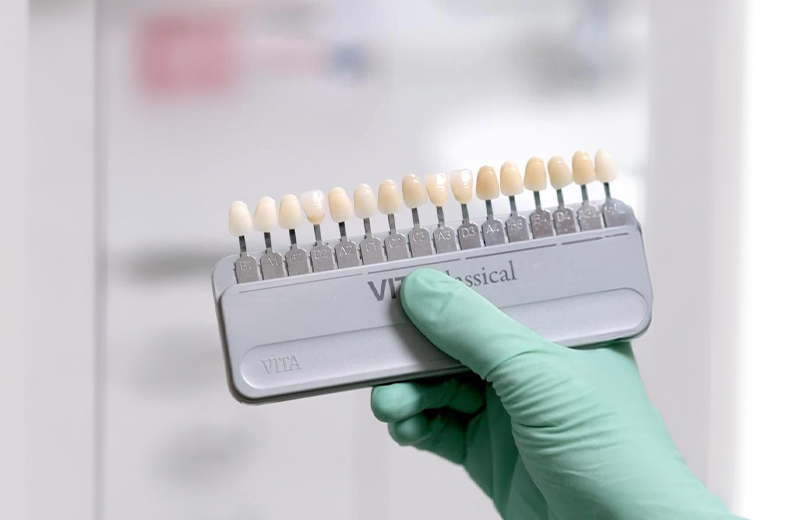
- Comprehensive Oral Assessment & Baseline Shade Mapping: We evaluate the health of your enamel and gums to confirm candidacy. Using a standardized VITA shade guide and high-resolution digital imaging, we record your baseline tooth shade.
- Surface Preparation (Prophylaxis): If plaque or surface calculus is present, light polishing is performed to ensure the whitening agent contacts pristine enamel surfaces uniformly.
- Soft-Tissue Isolation: Retractors hold the lips and cheeks comfortably away from the teeth. We apply a medical-grade liquid gingival dam along the gumline and light-cure it to form a protective barrier over the gum tissues.
- Application of Clinical-Grade Bleaching Gel: A layer of pH-buffered hydrogen peroxide gel, enriched with potassium nitrate and fluoride to prevent sensitivity, is carefully brushed onto the visible aesthetic zone (typically the upper and lower front 8 to 10 teeth).
- Laser Exposure Cycles: The dental laser is passed systematically over each tooth in controlled intervals (typically 3 to 4 cycles of 2-4 minutes each). Fresh gel is reapplied between cycles to maintain peak oxidative efficacy.
- Barrier Removal & Enamel Rehydration: Once the desired shade progression is achieved, the gel and gingival barrier are rinsed away. We apply a soothing remineralizing agent containing calcium phosphate and topical fluoride to seal the enamel tubules.
- Final Shade Comparison & Care Guidance: We record your final shade against your baseline photographs and provide clear aftercare instructions to help maintain your brighter smile.
Schedule Your Laser Teeth Whitening in Greater Kailash 1
Restore your smile’s brightness with supervised in-clinic laser whitening at Tooth & Tonic.
- Direct Call: 098216 54499
- WhatsApp Consultation: Message Us on WhatsApp
- Clinic Address: R 98, Lower Ground Floor (LGF), Block R, Greater Kailash-1, New Delhi 110048
- Convenient Access: Located in Block R, Greater Kailash 1, minutes away from M-Block and N-Block markets, with reserved patient parking and direct ground-level access
In-Clinic Laser Whitening vs. Over-The-Counter Alternatives
| Feature | Professional Laser Whitening (Tooth & Tonic GK1) | Over-The-Counter Strips & Trays |
| Supervision | Conducted by experienced dental clinicians | Self-administered without clinical diagnosis |
| Activation Method | Targeted Dental Diode Laser | No activation or low-power retail LED |
| Gum Protection | Custom light-cured gingival barrier | None (high risk of chemical gum burns) |
| Enamel Safety | pH-neutral gels with desensitizers & fluoride | Frequently acidic; risks enamel micro-abrasion |
| Treatment Time | Single 45- to 60-minute in-clinic session | Requires daily use over 2 to 4 weeks |
| Predictability | High, uniform shade improvement | Uneven, patchy results across misaligned teeth |
Candidacy: Who Is Suitable for Laser Whitening?
Laser teeth whitening is effective for a broad range of patients, but an initial clinical evaluation is essential:
- Ideal Candidates: Adults with healthy gums and teeth who have yellow, orange, or brown discoloration caused by coffee, tea, red wine, dark sauces, tobacco, or general aging.
- Pre-Treatment Requirements: Any active dental conditions—such as untreated cavities, exposed dentin, or gingivitis—must be addressed prior to whitening to avoid pulp sensitivity. A routine scaling and polishing is often recommended first for optimal results.
- Special Considerations: Existing restorations like composite resin fillings, porcelain crowns, or veneers do not respond to whitening agents. If you plan to replace older front restorations, whitening is completed first so the new ceramics can be shade-matched to your brighter natural teeth.
- Alternative Options for Deep Stains: Severe, dark gray discoloration caused by childhood tetracycline use or advanced dental fluorosis may require multi-session treatments or conservative aesthetic solutions such as porcelain veneers.
Post-Whitening Care: The 48-Hour "White Diet"
During the first 24 to 48 hours following clinical whitening, the microscopic pores of your tooth enamel remain slightly open and are more susceptible to absorbing dark pigments while the protective salivary pellicle layer naturally reforms. To preserve your results, we advise:
- Foods to Enjoy: Water, milk, plain yogurt, white rice, steamed chicken, white fish, tofu, cauliflower, peeled potatoes, and clear broths.
- Foods to Avoid: Espresso, black or green tea, dark colas, red wine, turmeric-heavy curries, soy sauce, balsamic vinegar, berries, and tomato sauces.
- Tobacco Abstinence: Refrain from smoking, vaping, or using tobacco products for at least 48 hours post-treatment.
- Temperature Management: Avoid excessively hot or ice-cold beverages for the first 24 hours to keep teeth comfortable while the enamel rehydrates
Frequently Asked Questions (GK 1)
How many shades whiter can I expect my teeth to become?
Results vary depending on your baseline enamel density, age, and whether the discoloration is extrinsic or intrinsic. On average, patients experience an improvement of 1 to 2 shades on the clinical shade guide following a full in-office laser treatment.
Does laser teeth whitening erode or damage tooth enamel?
No. Professional dental whitening is non-abrasive. The chemical reaction focuses entirely on oxidizing organic stain pigments embedded within the enamel prisms and dentin; the underlying hydroxyapatite mineral structure of your tooth remains intact.
Will I experience pain or tooth sensitivity after the procedure?
Most patients experience minimal to no discomfort. Our clinic utilizes pH-balanced formulations fortified with potassium nitrate to soothe nerve endings. Mild, temporary sensitivity to cold beverages can occasionally occur, but it generally subsides within 24 to 48 hours.
How long do the whitening results typically last?
Results typically last between 12 and 24 months. Longevity depends largely on dietary choices and oral hygiene habits. Limiting stain-causing foods, rinsing after dark beverages, and scheduling regular biannual cleanings at our GK 1 clinic helps prolong your shade.
Can I schedule laser whitening before an upcoming wedding or event in South Delhi?
Yes. Because in-clinic laser whitening is completed in a single 45- to 60-minute visit, it is ideal for special occasions. We recommend booking your appointment 3 to 5 days before your event to allow the shade to stabilize and the enamel to fully rehydrate
Will laser whitening lighten existing fillings, veneers, or crowns?
No. Whitening agents react only with natural organic tooth structure. Dental ceramics, porcelain, and composite resins do not lighten. If you have visible anterior restorations, our dentists will plan your treatment so any replacement restorations match your updated natural shade.
Where is Tooth & Tonic located in Greater Kailash 1?
Tooth & Tonic is located at R 98, Lower Ground Floor (LGF), Block R, Greater Kailash-1, New Delhi 110048. We are centrally located within GK 1, just a short 3- to 5-minute drive from M-Block Market and N-Block Market. The clinic is easily accessible from neighboring areas such as Greater Kailash 2 (GK2), Kailash Colony, Defence Colony, East of Kailash, Chittaranjan Park (CR Park), and Nehru Place
How long does a complete laser whitening appointment take at your clinic?
A standard whitening appointment takes approximately 60 to 75 minutes. This covers initial shade assessment, lip and gum barrier placement, three to four 15-minute laser cycles, barrier removal, and final remineralization.