Dental Crowns vs. Bridges: Choosing the Right Restoration in Greater Kailash 1 | Tooth & Tonic Advanced Prosthodontics, Tooth Preservation & Fixed Tooth Replacement in GK 1 When a tooth suffers extensive structural breakdown or is lost entirely, the impact reaches far beyond smile aesthetics. Everyday activities like chewing comfortably, speaking clearly, and maintaining natural …

Dental Crowns vs. Bridges: Choosing the Right Restoration in Greater Kailash 1 | Tooth & Tonic
Table of Contents
Advanced Prosthodontics, Tooth Preservation & Fixed Tooth Replacement in GK 1
When a tooth suffers extensive structural breakdown or is lost entirely, the impact reaches far beyond smile aesthetics. Everyday activities like chewing comfortably, speaking clearly, and maintaining natural jaw alignment become compromised. Missing or fractured teeth disrupt the delicate biomechanics of the mouth: adjacent teeth tilt and drift into open spaces, opposing teeth supra-erupt, and uneven bite forces accelerate enamel wear while placing mechanical strain on the temporomandibular joints (TMJ).
Modern prosthodontic dentistry offers reliable, fixed restorations to re-establish oral health and chewing efficiency. Two of the most widely performed treatments are dental crowns and dental bridges.
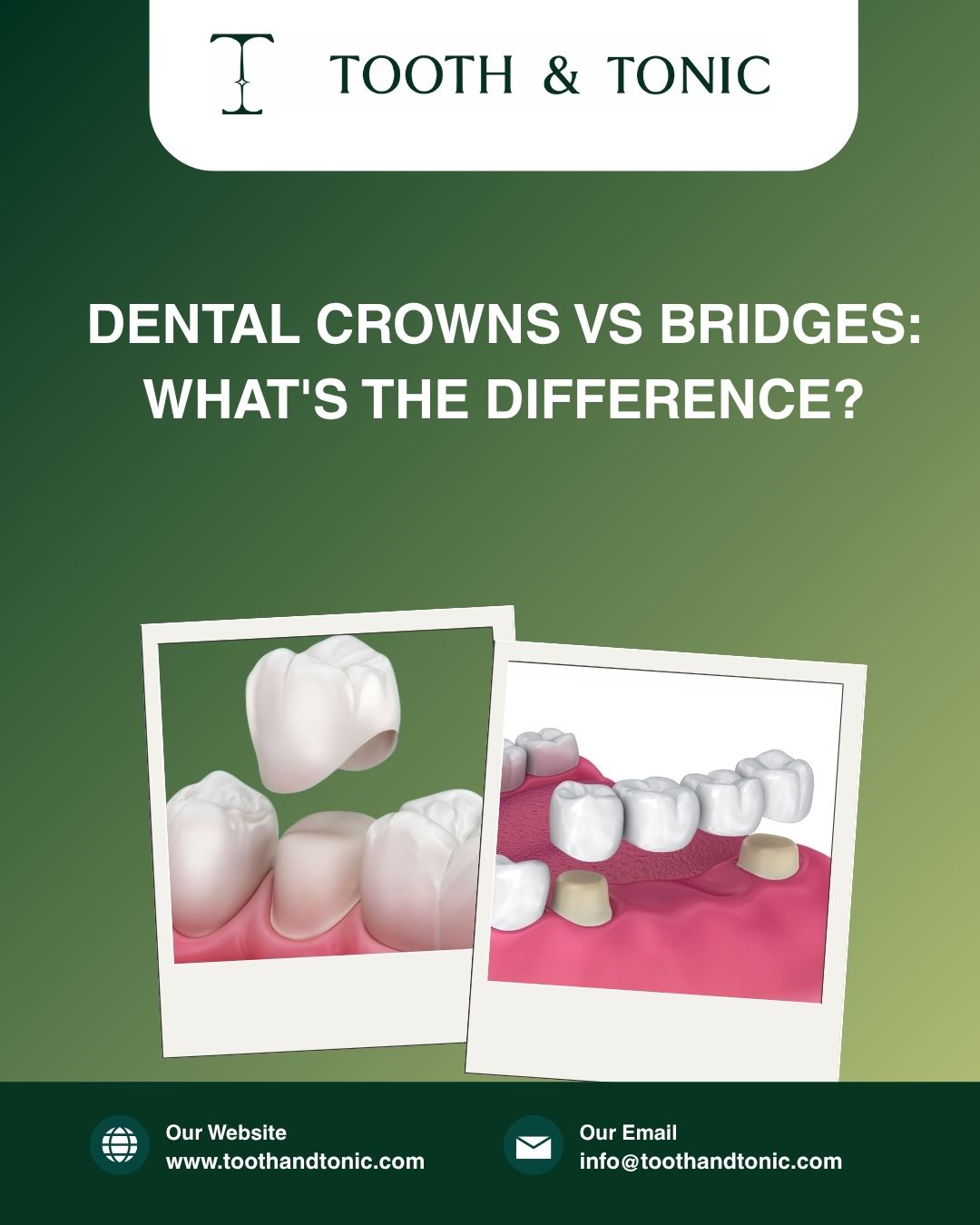
Although they are frequently discussed together, crowns and bridges address fundamentally different clinical needs:
A Dental Crown is designed to save, reinforce, and protect an existing natural tooth that is structurally compromised.
A Dental Bridge is designed to replace one or more completely missing teeth by bridging the physical gap in the dental arch.
At Tooth & Tonic, located in Block R, Greater Kailash-1, restorative treatment planning is guided by digital precision, biomimetic conservation, and material durability. Here is an in-depth comparison of dental crowns versus dental bridges to help you understand which restorative option best aligns with your oral health requirements.
What Is a Dental Crown?
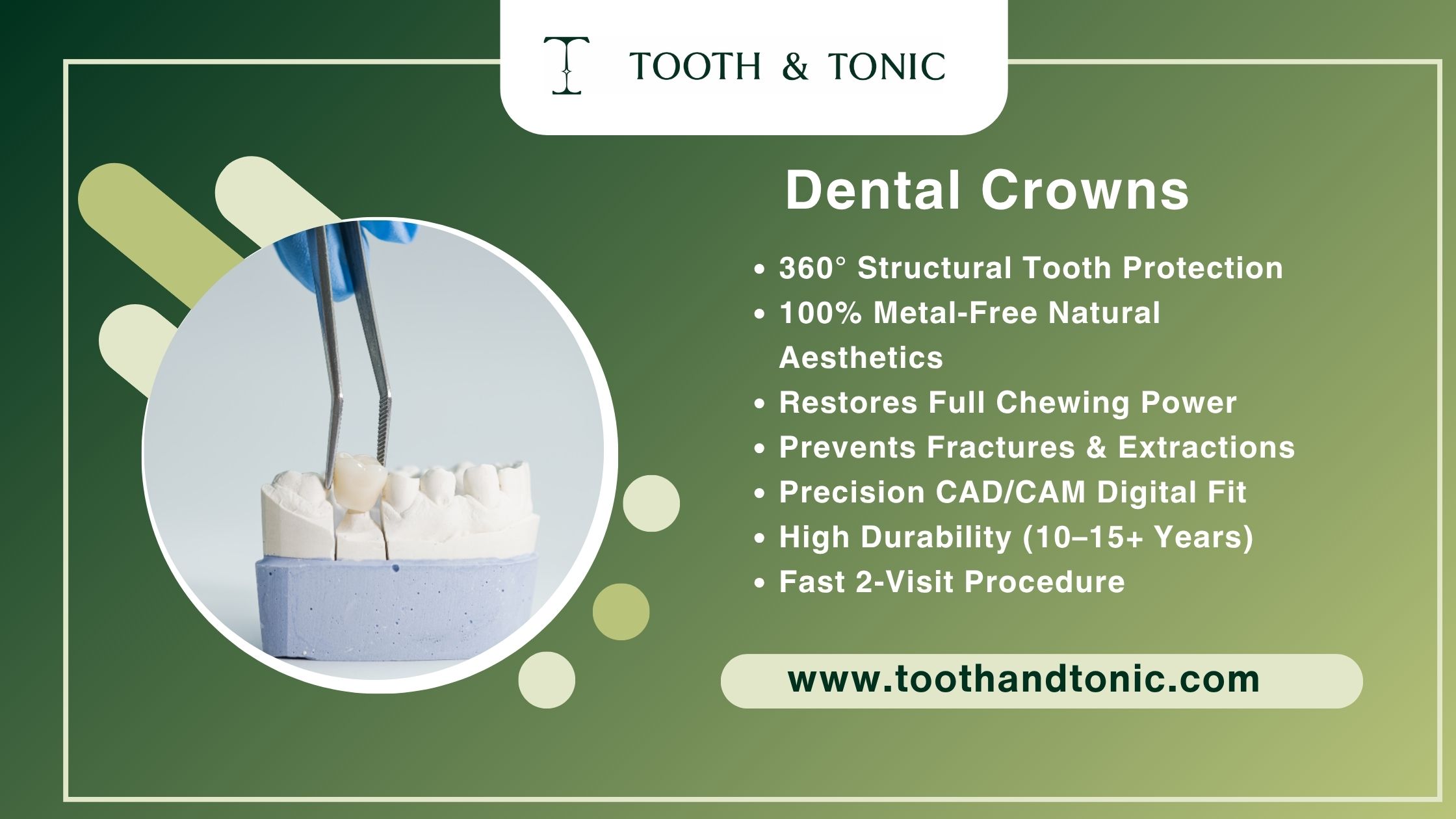
A dental crown—often referred to as a tooth cap—is a custom-engineered, full-coverage restoration that encases the entire visible portion of a damaged or weakened tooth above the gumline. By acting as a protective 360-degree shield, a crown restores the tooth’s structural integrity, natural shape, chewing anatomy, and aesthetic contours while shielding it from biting pressures that could cause catastrophic fractures.
Clinical Indications for a Dental Crown
Our dental specialists in GK 1 typically recommend a dental crown when:
A tooth has undergone root canal treatment: Root-treated teeth lose internal vascular moisture over time, becoming brittle and highly susceptible to vertical root fractures under everyday chewing forces.
Extensive dental decay is present: Large cavities that undermine more than half of the natural tooth width leave remaining enamel walls too weak to support a conventional composite filling.
Cracked Tooth Syndrome occurs: Teeth with micro-fractures that cause sharp pain on biting benefit from the splinting effect of a crown, which redistributes occlusal forces evenly.
Severe attrition or acid erosion: Chronic nighttime teeth grinding (bruxism) or chemical acid wear flattens chewing surfaces, requiring crowns to rebuild proper vertical bite height.
Restoring a dental implant: A custom crown serves as the final, functional prosthetic tooth secured to an integrated dental implant fixture.
Restorative Materials Used for Crowns at Tooth & Tonic GK 1
Monolithic High-Translucency Zirconia: Milled from solid blocks of biocompatible zirconium oxide, monolithic zirconia provides exceptional flexural strength. It resists chipping and handles heavy biting forces on back molars while matching natural tooth shades.
Lithium Disilicate (IPS E.max Ceramic): The gold standard for front teeth and visible premolars. E.max glass-ceramic replicates natural enamel opalescence, light refraction, and subtle translucency.
Porcelain-Fused-to-Zirconia (PFZ): Combines a high-strength zirconia core framework with hand-stacked aesthetic porcelain on the outer surface for balanced strength and beauty.
Metal-Free Formulations: We prioritize biocompatible, metal-free restorations that prevent dark metallic collars at the gumline and eliminate concerns regarding metal sensitivities.
What Is a Dental Bridge?
A dental bridge is a fixed, non-removable prosthetic restoration designed to replace one or more missing consecutive teeth. Instead of covering an isolated tooth, a bridge spans the empty space created by tooth loss.
A traditional bridge consists of two main components:
Abutments: The crowns placed over the natural teeth (or dental implants) on either side of the empty space, which act as structural anchors.
Pontic: The custom-crafted replacement tooth (or teeth) suspended between the abutments, resting lightly on the gum tissue to restore chewing function and aesthetics.
When Is a Dental Bridge Recommended?
A prosthodontist or dentist may recommend a dental bridge if:
One or more consecutive teeth are missing from the dental arch.
The adjacent teeth flanking the gap have healthy root structures and adequate bone support to act as anchors.
The adjacent teeth already have large existing fillings or crowns, making them practical candidates for abutment reshaping.
The patient desires a secure, fixed replacement without wearing a removable partial denture.
A non-surgical restoration is preferred, or bone volume is insufficient for immediate dental implants without prior bone grafting.
Types of Dental Bridges
Traditional Fixed Bridges: The most common configuration, anchoring the replacement pontic between two full-coverage crowns placed on the natural teeth flanking the gap.
Cantilever Bridges: Utilized when an anchor tooth is available on only one side of the missing tooth gap. These require careful bite-force evaluation to prevent torsional stress on the supporting tooth.
Maryland (Resin-Bonded) Bridges: A conservative option frequently used for missing front teeth. The replacement tooth is secured by metal or ceramic “wings” bonded to the backs of adjacent teeth, requiring minimal enamel preparation.
Implant-Supported Bridges: When three or more teeth are missing, dental implants serve as the foundational anchors instead of natural teeth, protecting adjacent natural enamel from being altered.
Dental Crowns vs. Bridges: Direct Comparison
| Feature | Dental Crown | Dental Bridge |
| Primary Clinical Purpose | Restores and reinforces a damaged natural tooth | Replaces one or more missing natural teeth |
| Number of Teeth Involved | Single tooth per restoration | Minimum of three units (two anchors + one pontic) |
| Impact on Adjacent Teeth | None; adjacent natural teeth remain untouched | Anchor teeth must be contoured to accept crowns |
| Biological Role | Preserves existing natural tooth structure & root | Bridges an edentulous space to stop teeth shifting |
| Hygiene & Flossing | Flossed normally like a natural tooth | Requires bridge flossers, superfloss, or water flossers |
| Chewing Restoration | Restores individual tooth function | Re-establishes multi-tooth chewing efficiency |
| Removability | Fixed permanently with adhesive resin cement | Fixed permanently with adhesive resin cement |
Schedule a Restorative Consultation in Greater Kailash 1
Determine whether a custom ceramic crown, fixed bridge, or dental implant is best for your smile with the prosthodontic team at Tooth & Tonic.
Direct Call: 098216 54499
WhatsApp Direct: Chat with Us on WhatsApp
Clinic Address: R 98, Lower Ground Floor (LGF), Block R, Greater Kailash-1, New Delhi, Delhi 110048
Location Details: Centrally located in Block R, Greater Kailash 1, minutes away from M-Block and N-Block markets, with reserved patient parking assistance and direct ground-level access.
How Does a Dentist Decide Between a Crown and a Bridge?
Selecting the ideal restoration is a personalized clinical decision. During your diagnostic examination at our Greater Kailash 1 clinic, our clinicians evaluate several anatomical and lifestyle factors:
Presence vs. Absence of the Tooth: If the root and substantial coronal tooth structure remain intact, a dental crown is the conservative treatment of choice to preserve your natural anatomy. If the tooth is absent or non-restorable and must be extracted, a bridge or dental implant is indicated.
Condition of Adjacent Anchor Teeth: If the teeth neighboring an empty gap are completely healthy, decay-free “virgin” teeth, preparing them for bridge crowns involves removing sound enamel. In such scenarios, a single standalone dental implant is often the superior biological choice. If neighboring teeth already have large failing fillings or need crowns themselves, a dental bridge provides an efficient dual solution.
Periodontal & Bone Support: Anchor teeth for a bridge must have stable alveolar bone levels and healthy surrounding periodontal ligaments to handle the compounded chewing forces of the missing tooth.
Occlusal Dynamics & Bruxism: Heavy clenching or grinding habits require high-strength materials like monolithic zirconia and night guard protection to prevent ceramic chipping.
Oral Hygiene Compliance: Bridges require dedicated hygiene beneath the pontic. Patients unable or unmotivated to use specialized floss threaders may face recurrent decay on the supporting anchor teeth over time.
Can a Dental Implant Be an Alternative to a Bridge?
Yes. In contemporary restorative dentistry, dental implants are frequently the preferred alternative to traditional dental bridges for replacing missing teeth.
Unlike a bridge, a dental implant replaces the missing tooth root by surgically placing a biocompatible titanium or ceramic fixture directly into the jawbone.
Advantages of an Implant Over a Dental Bridge:
Zero Impact on Adjacent Teeth: Neighboring teeth do not need to be reshaped or crowned.
Bone Preservation: Implants stimulate the jawbone through osseointegration, preventing the bone loss that naturally occurs beneath the pontic of a bridge.
Independent Hygiene: An implant crown is brushed and flossed exactly like an individual natural tooth.
However, a dental bridge remains an excellent option for patients who prefer a rapid, non-surgical solution (completed in 2 visits over a few days), those with medical conditions that contraindicate minor oral surgery, or individuals with insufficient bone volume who prefer to avoid bone grafting procedures.
Caring for Crowns and Bridges: Daily Maintenance
While porcelain and zirconia materials cannot develop cavities, the natural tooth margins beneath crowns and supporting bridge abutments remain vulnerable to plaque accumulation and bacterial leakage:
Brush Twice Daily: Clean along the gumline with a soft-bristled toothbrush and non-abrasive fluoride toothpaste.
Clean Underneath Bridge Pontics Daily: Traditional floss cannot pass through joined teeth. Use specialized spongy superfloss, plastic floss threaders, or interdental brushes daily to sweep away trapped food particles and bacteria beneath the artificial tooth.
Incorporate an Oral Irrigator (Water Flosser): Pulsed water streams flush out plaque around crown margins and under bridge frameworks effortlessly.
Wear a Protective Night Guard: If you clench or grind your teeth during sleep, a custom-milled hard acrylic splint protects your restorations from excessive bite loads.
Maintain Routine Biannual Check-Ups: Visit our GK 1 clinic every six months for professional scaling, polishing, and marginal seal checks.
Frequently Asked Questions for Greater Kailash 1 (GK 1) Patients
What is the primary difference between a dental crown and a dental bridge?
A dental crown covers and reinforces a single damaged or root-treated natural tooth to prevent fracture. A dental bridge replaces one or more completely missing teeth by anchoring an artificial tooth (pontic) between crowns placed on adjacent teeth.
Is the preparation procedure for crowns or bridges comfortable?
Yes. Both treatments are performed under targeted localized numbing, ensuring you remain comfortable throughout the appointment. While you may feel gentle vibration during tooth reshaping, there is no sharp sensation. Any mild, temporary gum tenderness following the appointment typically resolves within 24 to 48 hours.
How long do dental crowns and bridges last?
High-grade monolithic zirconia and E.max ceramic crowns and bridges typically last 10 to 15 years, and often much longer with diligent oral hygiene, regular cleanings, and night guard protection if bruxism is present.
Which is better: a dental bridge or a dental implant?
Neither is universally superior; each serves distinct clinical indications. A dental implant is the gold standard for preserving adjacent healthy teeth and stimulating underlying bone. A dental bridge is ideal for patients who want a fast, non-surgical tooth replacement or whose adjacent teeth already require crowns.
Can a dental crown or bridge fall off?
While modern adhesive resin cements create durable bonds, a crown or bridge can occasionally loosen due to recurrent decay along the margins, biting on extremely hard objects, or cement degradation over many years. If a restoration loosens, contact our GK 1 reception desk at 098216 54499 immediately so our clinicians can evaluate and re-cement it.
Is a root canal always required before getting a dental crown?
No. Many teeth receive crowns simply because of extensive decay, large worn fillings, or cracked enamel while the dental pulp remains healthy and vital. A root canal is only performed if diagnostic testing confirms that the nerve inside the pulp chamber is irreversibly inflamed or infected.
How many visits are needed to complete a crown or bridge at your GK 1 clinic?
Both treatments are typically completed across two visits over 3 to 5 days. During visit one, teeth are prepared, digitally scanned using our 3D intraoral scanner, and protected with aesthetic temporary restorations. During visit two, the permanent restorations are verified for fit, shade match, and bite balance before being permanently bonded.
Why are metal-free zirconia and E.max crowns preferred over older metal-ceramic (PFM) crowns?
Porcelain-Fused-to-Metal (PFM) restorations feature an internal metal shell that can reveal an unsightly dark gray line at the gumline as gums naturally age. Furthermore, porcelain can shear away from metal under heavy chewing forces. Metal-free zirconia and E.max ceramics are tooth-colored throughout, biocompatible, chip-resistant, and mimic natural light refraction.
Where in Greater Kailash 1 is Tooth & Tonic located?
Tooth & Tonic is located at R 98, Lower Ground Floor (LGF), Block R, Greater Kailash-1, New Delhi 110048. Our practice is centrally situated within GK 1, just a short 3- to 5-minute drive from M-Block Market and N-Block Market. We routinely serve patients from nearby South Delhi areas including Greater Kailash 2 (GK2), Kailash Colony, East of Kailash, Chittaranjan Park (CR Park), Pamposh Enclave, and Nehru Place. Reserved patient parking and valet assistance are available on arrival.
How do I clean underneath a dental bridge?
Because the artificial tooth is connected to the anchor crowns, you cannot pass floss straight down from the top. Our team demonstrates how to use floss threaders, superfloss, interdental brushes, or water flossers that slide easily underneath the false tooth to keep the gum tissue clean and healthy.